What problem?
Challenges on developing scalable applications on GPU clusters.
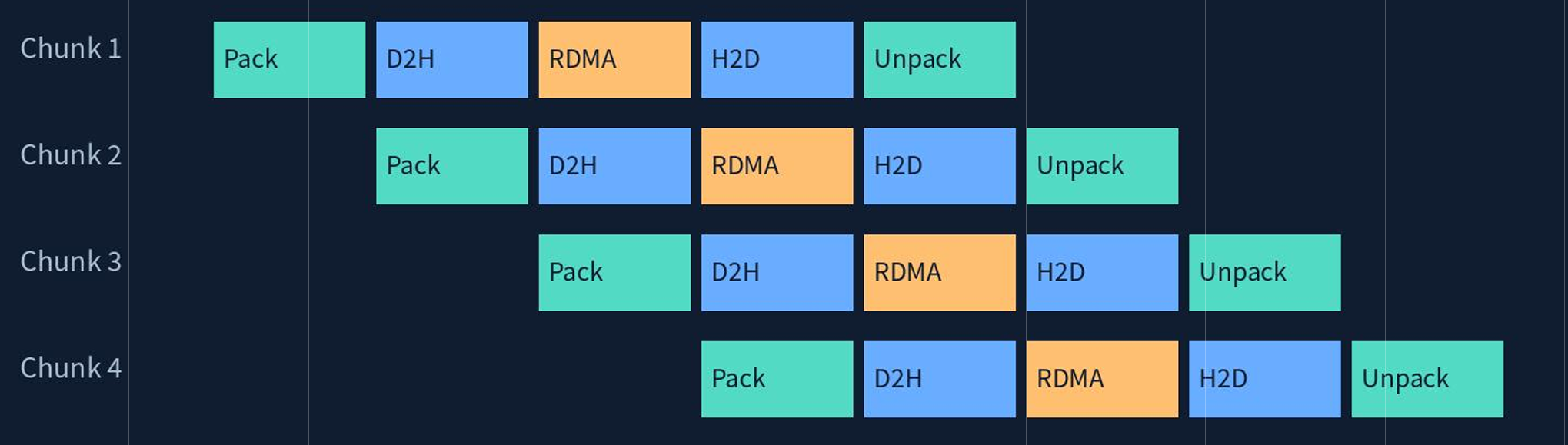
- Separate Memory Spaces: Programmers have to use CUDA or OpenCL to access the device memory and move data between CPU and GPU; and use distributed memory programming models, such as MPI, to transfer data on different nodes.
- Data Type Support Requirement: Scientific applications often need to deal with multidimensional and non-contiguous data, which is not naturally supported by MPI on GPU.
- Programming Complexity: Programmers need to manually divide data into chunks for overlapping communication between nodes. Non-contiguous data will also be taken into consideration.
- Increased Latency: MPI runtime uses polling mode to handle message. The step of moving data back into GPU device may get delayed as the MPI library continue handling other incoming message.
- Portability: Without a system level mechanism, programmers have to tune data communication for different hardware configurations.
Some Background
The environment in this work does not support GPUDirect RDMA. The following sequence is sufficient for data communication: GPU memory → Host memory → Network → Host memory → GPU memory.
Lattice Boltzmann Method (LBM) is the driven application of this work. LBM includes data transfer between neighbors as following figure:
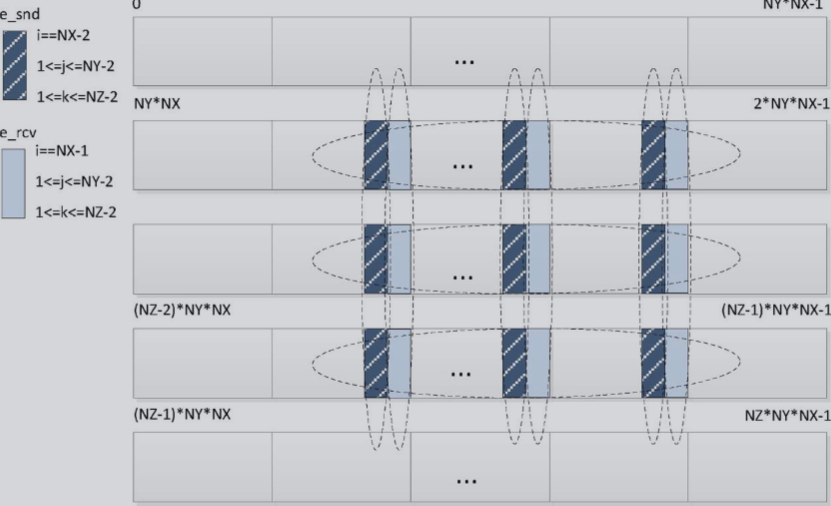
Boundary exchange in X dimension of 3D LBM.
Core Design
-
The MPI runtime will handle allocating memory: each process is allocated to a , which is allocated and freed in and .
Sender copy memory to → Sender handshakes with receiver to get remote address using Request to Send (RTS) message → Receiver sends back a Clear To Send (CTS) message including the remote address...
-
CPU traversing datatype to create a new data structure Input/Output Vector (IOV). Then transform any derived datatype to vectors and send to GPU. GPU kernel will do the data packing and unpacking.

MPI Datatypes defined in the MPI standard and supported by our designs. The ones used in the driven application are highlighted.
-
Asynchronous pipeline: Divide data into blocks called . Each block get one , which is allocated in GPU memory, and one CUDA event.
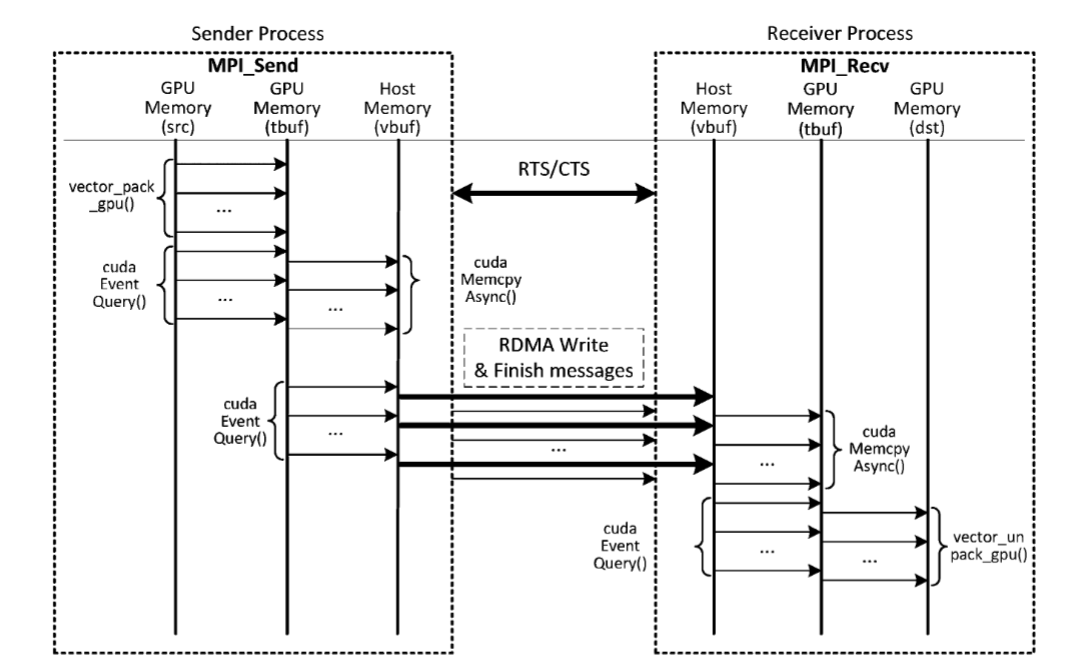
Asynchronous pipeline design in GPU-aware MPI.