[Note] BeaconKV: Key-Value Cache Compression Guided by Beacon Queries for Efficient Large Reasoning Model Inference
What problem?
- CoT (Chain-of-Thought) brings memory bottleneck (KV Cache), limits the practical deployment of LRMs (Large Reasoning Models) under constrained GPU resources.
Defects of previous solution
- They didn’t notice the distinction between LRM inference and conventional long-context processing.
- They tried to approximate tokens’ future importance by relying on recent queries at eviction time.
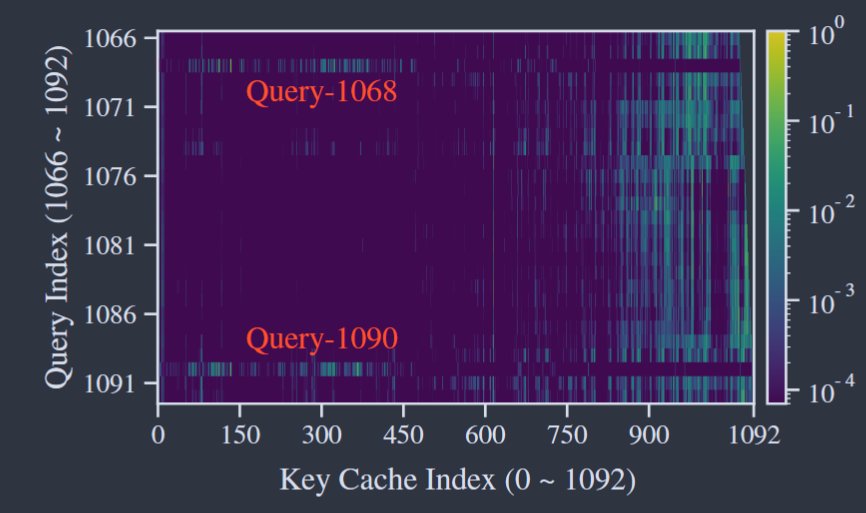
- However, this assumption fails in long-horizon reasoning: certain decoding steps generate TRT (Thought Revisiting Tokens) that re-attend to distant previous context.
Core innovation
- Key insight: The reasoning-critical context is revisited by global queries that form clusters in the pre-RoPE query space. The diverse set of global queries can be represented by a compact set of beacon queries–representative queries for each global query clusters.
- global queries: queries that attend to keys at substantially distant positions.
- global queries form a coherent subset that is geometrically distinct from the majority of local queries.
Unresolved vulnerabilities and possible improvement
1. “几何多样性”不等于“未来重要性”
FPS 选择的是最不相似、覆盖面最广的 query,但离群 query 可能只是噪声,而非未来 TRT 的代表。其核心假设——global query 会稳定聚类且可预测未来 attention——缺少更广泛验证。
可能改进:
- 结合 attention distance、历史访问频率和语义重要性;
- 使用 density-aware FPS,降低异常值影响;
- 对 beacon 设置效用分数和淘汰机制。
2. 当前位置 RoPE 对齐是一种启发式近似
将历史 beacon query 旋转到当前位置,并不一定能真实模拟未来 TRT。特别是在长距离外推、不同 RoPE scaling 或非 RoPE 模型上可能产生偏差。
可能改进:
- 使用多个候选未来位置进行 scoring;
- 学习或校准 position-remapping;
- 对 ALiBi、相对位置编码等架构设计专用版本。
3. Max aggregation 容易产生假阳性
只要某个 beacon 对某个 KV 给出高分,该 KV 就会被保留。异常 query 或单个 head 的尖峰可能占用大量预算,挤掉真正重要的内容。
可能改进:
- 使用 top-kk mean、分位数或温度化 LogSumExp;
- 增加跨 head 一致性;
- 对 beacon 设置置信度权重。
4. Eviction 不可逆且可能累积错误
某个关键 KV 一旦被错误删除,后续 beacon 无法恢复它。长推理中多轮 eviction 可能形成级联误差,使 query 分布进一步偏移。
可能改进:
- 周期性 dense rectification;
- 将低置信度 KV 暂存到 CPU/SSD;
- 使用压缩摘要或量化副本,而非直接永久删除;
- 监测模型不确定性并触发缓存恢复。
5. 固定的 local/global 配额并非普适
消融实验显示 beacon 太多会降低局部连贯性并显著增加延迟;beacon 太少又无法覆盖 TRT。论文采用 16 recent + 16 beacon,但这只是经验折中。
可能改进:
根据 attention entropy、TRT 频率、任务阶段及剩余显存动态分配两类 query。
6. 系统开销仍然存在
BeaconKV需要保存额外 query、运行 FPS,并在 eviction 时计算 beacon-to-cache attention。相同 budget 下,其吞吐略低、延迟略高于 RPC;在小 batch 或短序列上可能得不偿失。
可能改进:
- 降低 FPS 执行频率;
- 跨 head 共享 beacon;
- 使用近似最近邻或低维投影;
- 设计融合 CUDA kernel。
7. Prefix 永久保留可能侵占预算
方法始终保留 prefix 和最近 token。当 prompt 很长时,prefix 本身可能占据大部分预算,从而限制中间推理轨迹的可用空间。
可能改进:
对 prefix 也进行分层压缩,只硬保留指令和问题约束等关键部分。
8. 实验论证仍不充分
TRT 聚类分析主要依赖少量可视化案例和特定 layer/head;缺少:
- 不同模型上聚类稳定性的定量指标;
- TRT 识别的 precision/recall;
- 多次采样的方差和显著性检验;
- 超过 32K 长度下的误差累积实验;
- adversarial retrieval 或关键事实只出现一次的测试。
此外,不同 baseline 对 recent tokens 的保留数量并不完全一致,可能影响公平性。